
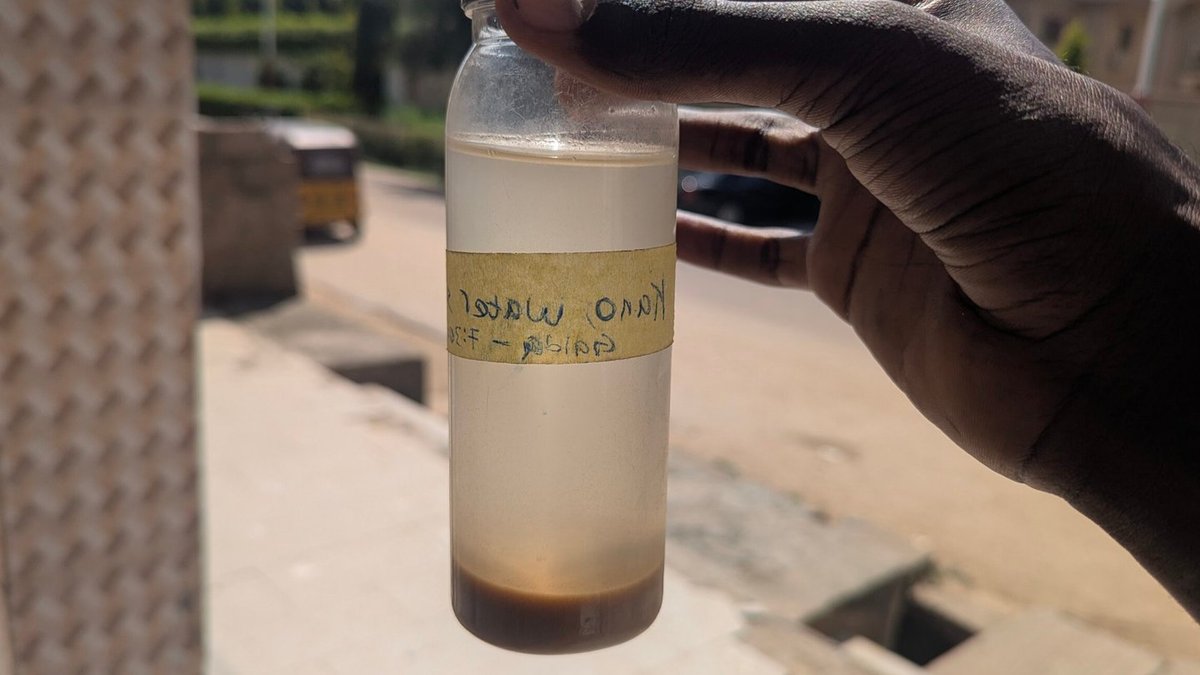
Khamis, a 55-year-old resident of Tamburawa in Kano State, never suspected the water flowing into his home could harm him until cholera took hold. For days, he endured vomiting, diarrhoea, and extreme weakness, spending over ₦60,000 ($45) on treatment. Even after recovering, one question haunted him: how could the water he paid ₦2,500 ($1.88) monthly for leave him sick, financially drained, and fearful for his children?
“It has been over a year since I last saw water that looked fit to drink,” Khamis said, describing the water flowing from his taps as brownish, foul-smelling, and filled with visible particles. Across Tamburawa, Tassa, Gaida, Panshekara, and other parts of Kano metropolis, residents face identical struggles: unreliable access to clean water. The supply is erratic, pushing households and businesses to spend more on alternatives despite billions of naira allocated to improve water infrastructure.
Water That Looks “Thick Like Coffee”
Hamisu Hussaini, a resident of Tassa, described the water reaching his home as “thick like coffee.” The smell was so strong that bathing in it left him feeling unclean. He noted that residents rarely complain because the same water board workers who deliver the water also collect monthly fees and disconnect households that fail to pay.
At Challawa Water Works, one of Kano’s three major treatment plants, officials refused access to the facility. An anonymous source familiar with the plant later reported that the government had not consistently supplied treatment chemicals to the plant for the past 5 months. The source further reported that the occasional supply of clean water to residents was made possible by water treatment chemicals donated by Mamuda, a private company, and that water quality deteriorated once the chemicals were exhausted. However, this claim could not be independently verified.
Shuarau Hamisu Garba, a tiger-nut juice seller, sometimes suspends her business for days or weeks because she cannot risk using the discoloured water supplied to her compound. She treats some of the water with WaterGuard, a chlorine-based product used to disinfect household water, adding a capful to 25 litres of water and letting it settle before use.
In September 2026, Nigeria Health Watch submitted a sample of muddy household water from Gaida Quarters in Kano Municipal to the Microbiology Laboratory at Murtala Muhammad General Hospital. A lab technician who examined the sample initially expressed concern about the visible particles and asked where the water had come from. However, when the laboratory result was eventually released from the hospital about a week later, the water was declared clean and without health impact.
Nigeria Health Watch commissioned Grand Consultancy Ltd to test a second water sample on September 17. The results differed from the hospital’s findings. Although the sample had a normal pH of 7.50, tests detected 50 colonies of total coliform bacteria per 100 ml and more than 100 MPN of E. coli per 100 ml. The report concluded that the sample “DOES NOT MEET drinking standards.”
Contamination and Conflicting Results
Public health expert Abba Isah explained that E. coli at these levels suggests faecal contamination, exposing residents to waterborne illnesses such as diarrhoea, typhoid, and cholera. A 2021 study using cholera surveillance data recorded 16,461 cases and 547 deaths in Kano State, a case-fatality ratio of 3.32%. The study identified 18 of the state’s 44 LGAs as cholera hotspots, covering a population of about 4.9 million.
Residents are left confused by the conflicting test results. If the water is unsafe, why do some tests show it is clean? If it is clean, why are people falling ill? The answers lie in inconsistencies in testing procedures and potential contamination points in the supply chain. Households pay for water that may not be safe, facing health risks as a result.
State budget reports show sharp fluctuations in water-sector funding. In mid-2025, Kano State increased its water-supply budget by 54%, from ₦17.89 billion ($11.3 million) to ₦27.63 billion ($17.5 million). However, the increase was uneven. Staff salaries remained unchanged, while capital spending on infrastructure rose by 53%. Overhead costs, covering daily administrative expenses, surged by 138%. By the second quarter of 2026, overhead spending reached 120.2% of the annual allocation.
By the end of the first quarter of 2026, less than 1% of the budgeted capital funds had been released, the lowest rate in an 18-month review. In May 2026, the state announced a ₦21.89 billion ($16.06 million) contract with Chinese firms to rehabilitate the Tamburawa-Challawa water system. By June, capital spending had reached just 10.1% of the annual allocation, a small fraction of the announced investment.
The government stated ₦9.9 billion ($7.26 million) would go to Challawa and ₦11.99 billion ($8.80 million) to Tamburawa. A separate report later adjusted these figures, allocating ₦9.9 billion ($7.26 million) to Tamburawa and ₦11.39 billion ($8.36 million) to Challawa and Goron Dutse. This pattern of delayed or uneven funding is not unique to the water sector.
Transparency and Accountability Demanded
On September 14, 2026, Nigeria Health Watch filed a Freedom of Information request with the Kano State Water Board. The request sought records on contracts, contractor payments, water-quality test results, maintenance reports, and resident complaints related to the ₦21.89 billion ($16.06 million) rehabilitation of the Tamburawa and Challawa facilities. It also asked for an inventory of water infrastructure across Kano State.
The request referenced the 2025 budget report, which showed only 31.5% of the revised allocation for water-supply projects had been spent, while just 0.6% of the 2026 allocation had been released by the end of the first quarter. Under the Freedom of Information Act, the Water Board was required to respond within seven days. As of the publication date, no records had been provided, nor had the board notified Nigeria Health Watch of any extension.